The Sydney Photography Club is an online community that enables various people to share their interest and passion for photography. Created on the 24th of January 2013, this Facebook based group – a subgroup of Studio 1A Sydney – opens up a platform for various individuals to openly communicate with one another and share their art. With nearly 14k members, this constantly growing group aims to support fellow photography lovers as it welcomes all genders, ages and cultures in Sydney to share artistic ideas, give advices on best places to take photo shoots, and answers regarding questions based on photography. By being a part of this community, people are introduced to create online and offline friendships based on similar interests. In fact, the group breaks out of the digital realm as people aim to regularly hold workshops and group photography events to keep the members of the community to remain engaged and active. Thus, through all these factors, it is evident that the Sydney Photography Club is a close and interactive digital community.
AFFORDANCES
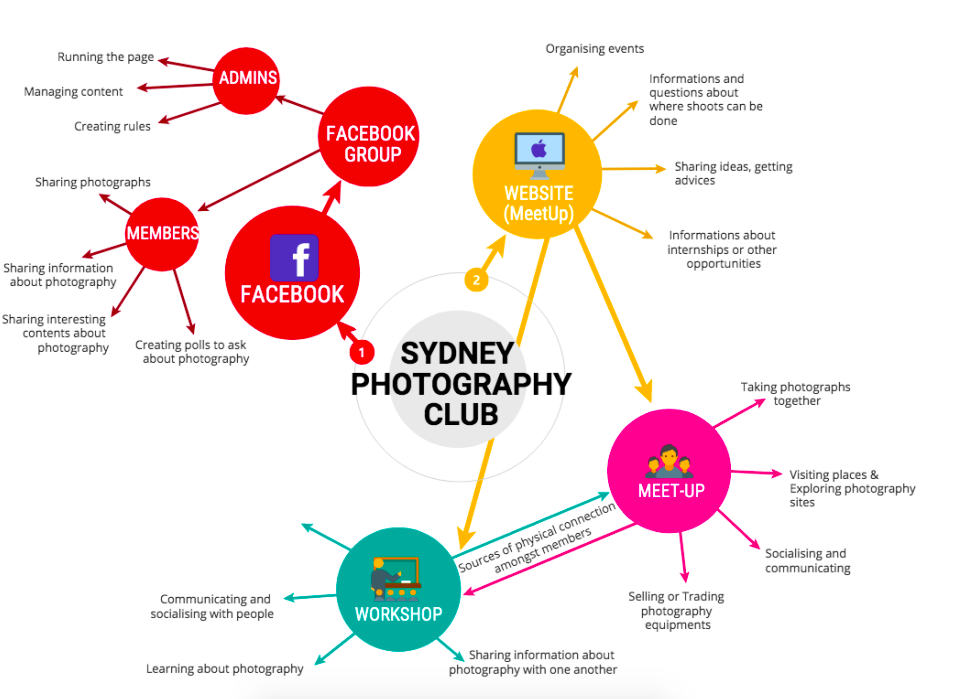
The Sydney Photography Group empowers individuals to engage as a member of a community and share their interest in photography. It provides a platform for people to communicate with one another to discuss and support their shared passion whilst also promoting photography to a wider audience.
The group actively engages members as it creates discussions about photography and also regularly holds workshops and meetups to offer members a chance to physically connect with one another. These workshops allow individuals to not only create new connections and relationships with peers, but also provides a chance to learn new skills and information about photography, thus enabling them to improve their understanding on photography. Interestingly, members can benefit from being a part of the group as not only are they able to share their art, but they can also receive feedback and critiques to improve from other members and gain a deeper and more extensive knowledge on photography.
Although members are unable to advertise or sell on the Facebook group in order to keep the page focused on photographic contents, they are able to spread their external knowledge such as internship programs, personal promotion for modelling, etc, through workshops and group events that are held regularly. These face-to-face communication events allows the group to provide individuals with meaningful connections and friendships with people who share the same interest. Thus, this community not only provides members with renewed information about photography and answers to queries, but also acts as a platform of communication as it paves way for individuals to gain a source of engagement from communicating with peers about personal interests.
INTERNAL AND EXTERNAL COMMUNICATION
The group has a strict set of rules set up by the group’s admins for members to follow in order to be able to stay in the group. The rules consists of basic manners that an individual should hold – how an individual should behave in an appropriate manner and interact with people in and out of the group in a kind and fair way, as well as what they can and cannot post – for instance, the regulation against advertising and selling, in order to keep the group strictly about photography. Due to these regulations, the community have a shared understanding of what is acceptable and allowed, forming the norms in the group. Through observing the Facebook page, we can clearly see that these rules create a coherent and friendly environment, allowing connections and communication to flourish amongst members, whilst at the same time allowing the common love of photography to be present and dominant.
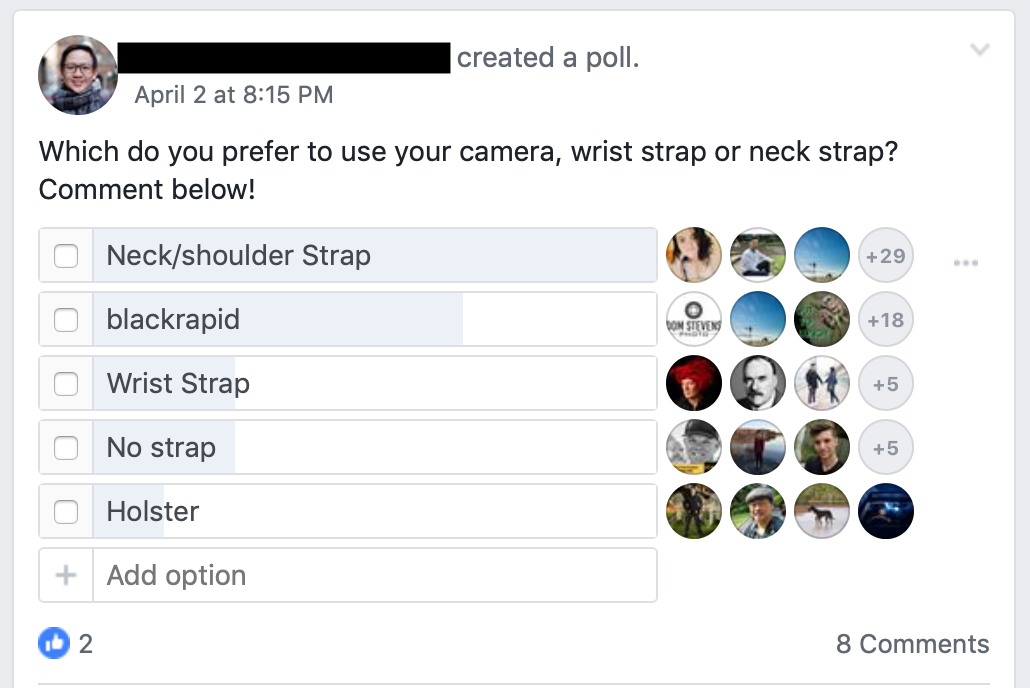
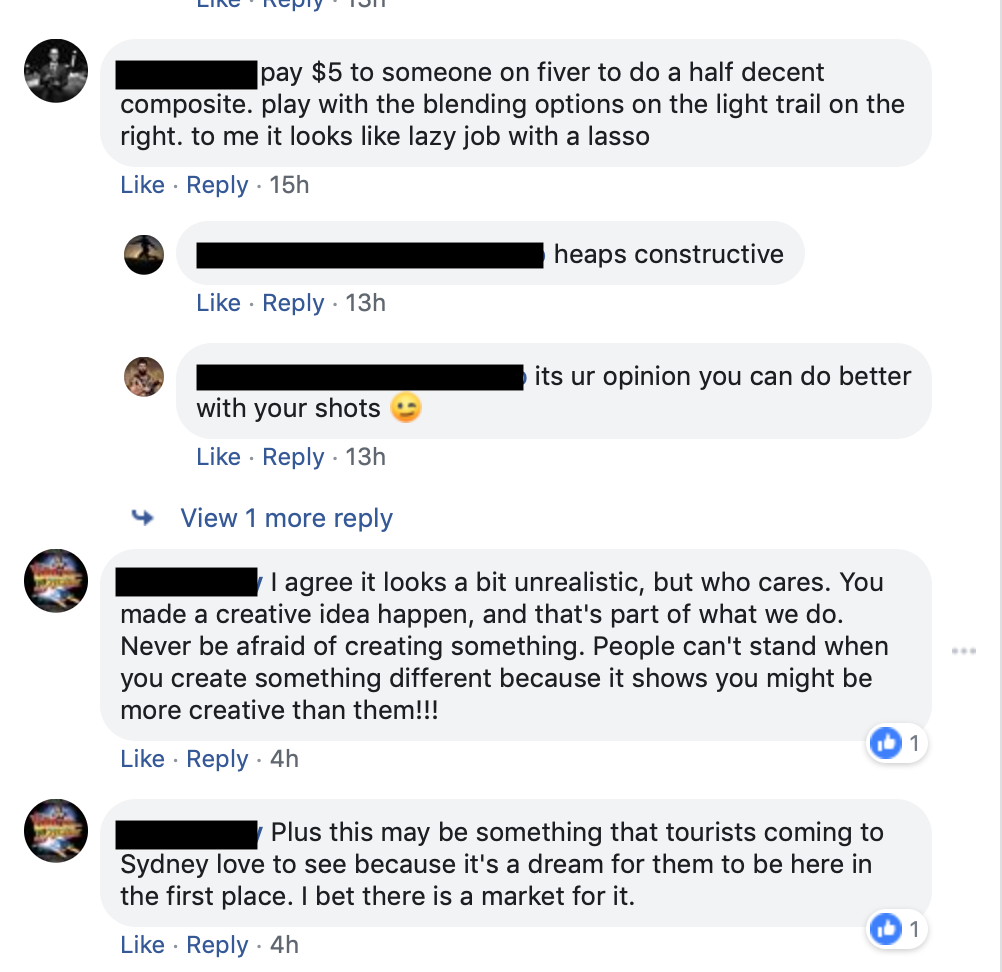
Although members of the group do not interact face-to-face, unless at events or workshops, the page is flooded with comments, feedback and reactions to one another’s posts. People interact in a way that many communities don’t, as they seem like a close family of 13 plus thousand people. Just through looking at the comments on photos, one can see many forms of interaction, one being question and answer, where members are able to pose questions to the group through polls or posts, such as what’s the best name for their photo or the best place to shoot, composed of broadly based relationships in which each community member felt securely able to obtain a wide variety of help” (Wellman, 1988,p 97)(see photo 1). This then gives other members the opportunity to help by sharing their knowledge of photography as well as offering ways to help improve others work, such as suggesting a software or camera to enhance an individual’s photography. Baym explains this by describing that “When people provide and receive social support in online groups, they are contributing to one another’s accumulated social capital” (Baym, 2010, p.82)(see photo 2). Not only can members get feedback on their work, they also get words of appraisal from others, encouraging them to continue doing what they love. This shows that the group interacts in an encouraging and supportive manner, making it a beneficial club and community to be a part of.
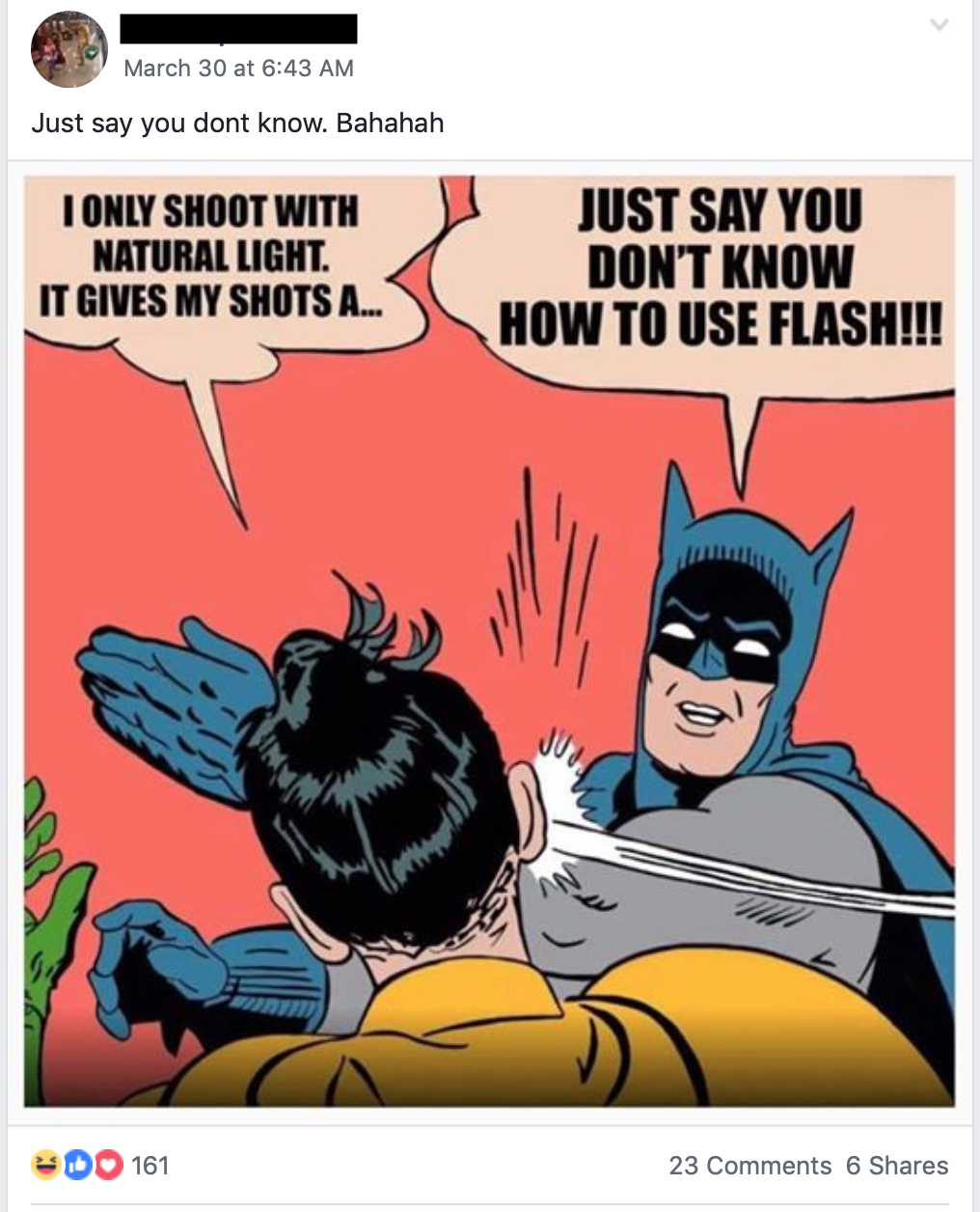
As Baym states “speech communities have distinctive patterns of language use which enact and recreate a cultural ideology that underpins them” (Baym, 2010, p.77). This is seen in the group as there are many shared practices regarding how people post their photography and the language they use that differs to other groups one would find on Facebook and other media platforms. The language used is what someone would classify as photography jargon, such as the use of the words “moment” to describe a photo, “capture”, and incorporating names of camera equipment, angles and lenses into their normal vocabulary. The group also posts memes and funny posts that only photographers would understand and find amusing (see photo 3), highlighting that their shared interest allows them to communicate in ways they are unable to in the real world.
The group mostly interact through the Facebook page, and tends not to engage with other groups on the platform, but through the use of the site ‘MeetUp’, can come together and form real connections. ‘MeetUp’ is where all the photography events and workshops are posted to ensure the Facebook doesn’t get cluttered and is easy to navigate. Events are set up by member to encourage people to be active and to participating in the group and photography its self, as well as exposing people to different types of photography styles and techniques. Not only are the external communications beneficial in an educational manner, it also makes the community stronger and closer. Baym describes this in quoting Rheingold “social aggregations that emerge from the Net when enough people carry on those public discussions long enough, with sufficient human feeling, to form webs of personal relationships”.
the group uses many forms of communication in and outside of the Facebook page. Interpersonal communication is evident in the group through members supporting each other, through giving advice and assistance, opinions and appraisal. This displays that members are exchanging messages and meaning through commenting on someone’s post. Thus, the posts allow discussion and debate in the comments as people many have differing views or asks questions about what is posted, allowing two-way communication to form. Additionally, presentational communication is not so evident in the group as everyone has the ability to comment, ask questions and voice their opinions on posts. The only example of presentational communication in this club is on the ‘MeetUp’ page, where information is presented about an event, making it a one-way exchange of messages intended to not start a discussion. Another example of this mode of communication on the external page is through advertising, which is also aimed to inform people and get them to act on their own account. However, despite the intended one-way communication in these posts, there is also interpersonal communicating as people are asking questions and others are answering. Therefore, the ‘Sydney Photography Club’ is mainly an interactive community which encourages member to interact with each other and create meaning.
Baym, Nancy 2010, ‘Communities and Networks (Chapter 4)’ in Personal Connections in the Digital Age, Cambridge, Polity Press
Gabriella Gris, Ashley Kim, Phuoc Thien Tran (Donny)
 Sydney photography club